
Documentation Index
Fetch the complete documentation index at: https://docs.heymilo.ai/llms.txt
Use this file to discover all available pages before exploring further.
Structured Questions
They are not scored on the 1–5 scale. Outcomes are pass or fail only. They do not change the candidate’s overall numerical score. For nuanced answers that should rank candidates, use scored questions — see How Scoring Works.Remember: Structured = binary screening. Scored = judgment + contribution to overall score. Use both in the same interview when it fits.
Structured vs scored (quick compare)
| Structured | Scored | |
|---|---|---|
| Outcome | Pass / fail | 1–5 |
| Overall score | Does not contribute | Contributes (with weights) |
| Dealbreaker | Optional auto-fail | No |
| Best for | Verifiable requirements | Behavior, depth, communication |
| Has 1–5 rubric / weight | No | Yes |
When to use structured questions
- Legal / policy: work authorization, licenses, certifications
- Numeric bars: minimum years with a tool, hours available, counts
- Knockouts: relocation, schedule, physical requirements, clearance
- Knowledge checks with a clear correct answer (multiple choice)
- Open-ended or behavioral prompts (“tell me about a time…”)
- Anything that needs nuance or grading on a spectrum → use scored questions
Question types
Yes / No
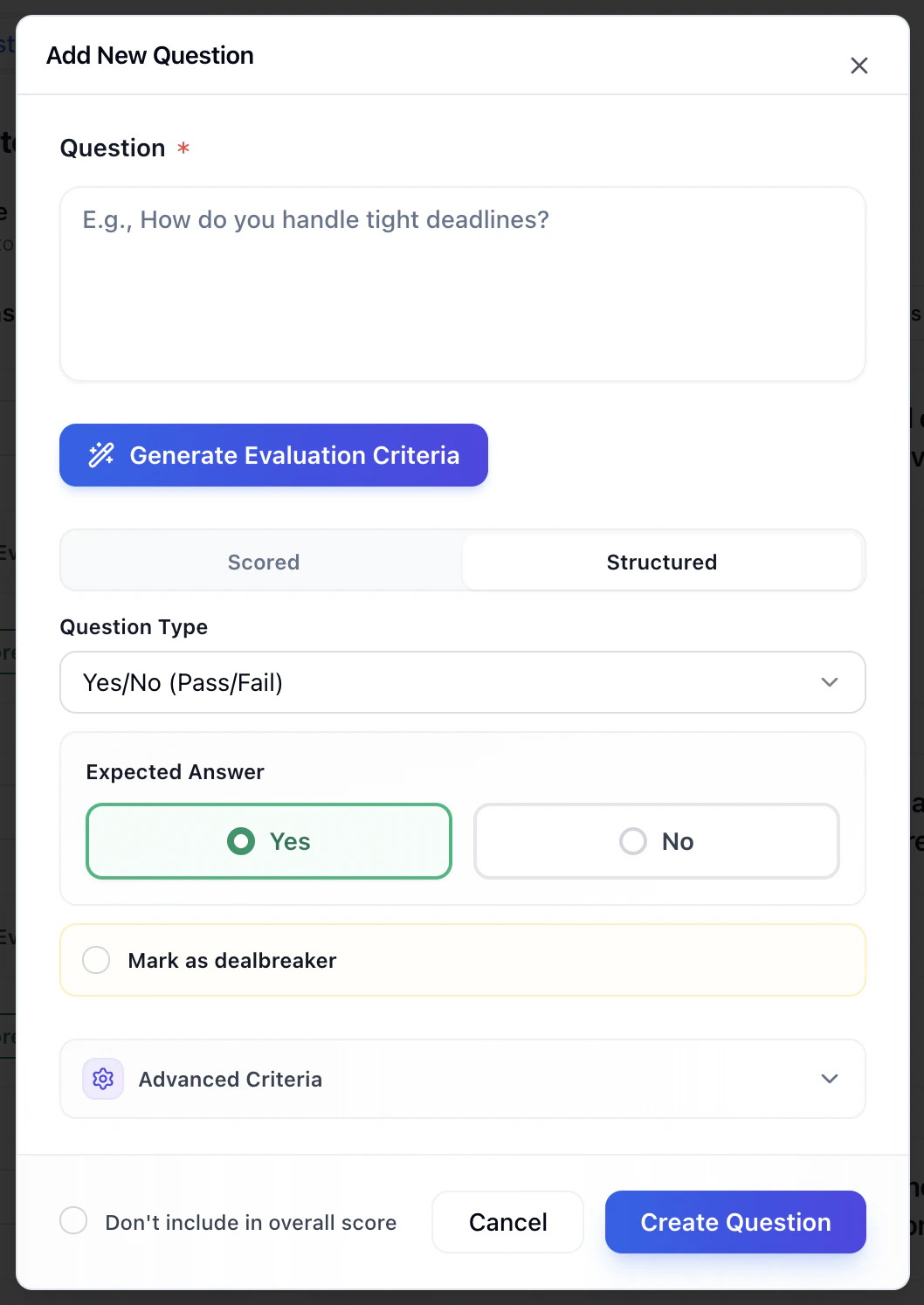
You set: expected answer (Yes or No). Dealbreaker (optional): fail anyone who answers wrong. Examples- Work authorization — expect Yes, dealbreaker on
- Physical requirement (e.g. lift 50 lbs) — expect Yes, dealbreaker on
- “Available to start within two weeks?” — expect Yes, dealbreaker off if it’s a preference
- “Willing to work occasional evenings/weekends?” — expect Yes, dealbreaker on if non-negotiable
Tips: One requirement per question. No double negatives. Phrase for clarity when read aloud by the AI; consider non-native speakers.
Minimum amount
You set: minimum value, optional unit (e.g. years, hours per week, certifications). The candidate passes if their answer meets or exceeds your minimum. Dealbreaker optional. Examples- Warehouse experience — min 3, unit years, dealbreaker on
- Python experience — min 3, unit years, dealbreaker on
- Weekly availability — min 20, unit hours per week, dealbreaker off
- Safety certifications — min 2, dealbreaker on
Tips: Name what you’re counting clearly. Keep thresholds realistic (e.g. don’t ask for impossible years on a new technology). The AI may probe equivalents in follow-ups — still keep the question itself precise.
Multiple choice
You set: up to four options, optional extra context per option, which option(s) count as correct (one or more). Dealbreaker optional. Examples- Shift willingness — options for morning / afternoon / evening / weekends; mark the combinations you require
- Equipment certified to operate — mark required certs (e.g. forklift + pallet jack)
- Languages or stacks used professionally — mark must-haves for the role
- “Comfortable with which databases?” — mark required vs nice-to-have; dealbreaker off if flexible
Tips: Cap at four options. Use short context to disambiguate. Don’t mark an unrealistic number of options as “correct.”
How to add them
When creating or editing voice/video questions:- Add New Question
- Open the Structured tab (not scored)
- Choose Yes/No, Minimum Amount, or Multiple Choice
- Enter question text
- Configure type-specific fields (expected answer, minimum + unit, options + correct answers)
- Turn on Mark as dealbreaker only if a fail should disqualify
- Save
Mixing structured and scored in one interview
Example flow- Structured Yes/No (dealbreaker): authorized to work in the US
- Structured minimum (dealbreaker): years of required skill
- Scored: challenging project, depth of experience
- Scored: judgment / communication
- Structured multiple choice (no dealbreaker): nice-to-have tool exposure
Best practices
- Put dealbreakers early so you don’t spend depth on candidates who can’t meet basics.
- Wording: specific, unambiguous, one ask per question; test how it sounds out loud.
- Dealbreakers: only for true must-haves — too many shrinks your funnel.
- Pilot: run the interview yourself; have a teammate try it; check pronunciation of technical terms.
- Multiple choice: use additional context sparingly but clearly — don’t bury candidates in text.
Common mistakes
- Unrealistic minimums (e.g. more years than the tech has existed) — align with the role and market.
- Compound Yes/No (“cloud and Docker?”) — split into two questions.
- Too many “correct” MC options — define what “qualified” actually means.
- Structured for subjective traits (“strong leader?” Yes/No) — use a scored behavioral question instead.
Reviewing results
For each structured item you’ll typically see:- Pass / fail
- What the candidate answered
- Short evaluation explaining the outcome
- Tie-in to the transcript where helpful
Tip: Even without dealbreakers, structured pass/fail fields are easy scan points when comparing candidates — still with no impact on the numerical overall score.
Next steps
- How Scoring Works — 1–5 anchors, weights, reports
- Interview Evaluation — Language proficiency rubrics (workspace)
- Configuring Your AI Interviewer — Workflow, questions, voice/video setup