
Documentation Index
Fetch the complete documentation index at: https://docs.heymilo.ai/llms.txt
Use this file to discover all available pages before exploring further.
Creating an interviewer
Creating an Interviewer
An interviewer is your AI screener for one role. You set the job, pick how candidates are screened (voice, SMS, form, or resume), add questions and scoring, then share a link or connect your ATS. Here’s the flow you’ll see in the app.1. Start from the dashboard
From the dashboard, click Create Interviewer to start a new interview experience.
2. Generate your interview plan
First, tell HeyMilo what role you’re hiring for so it can suggest an interview plan.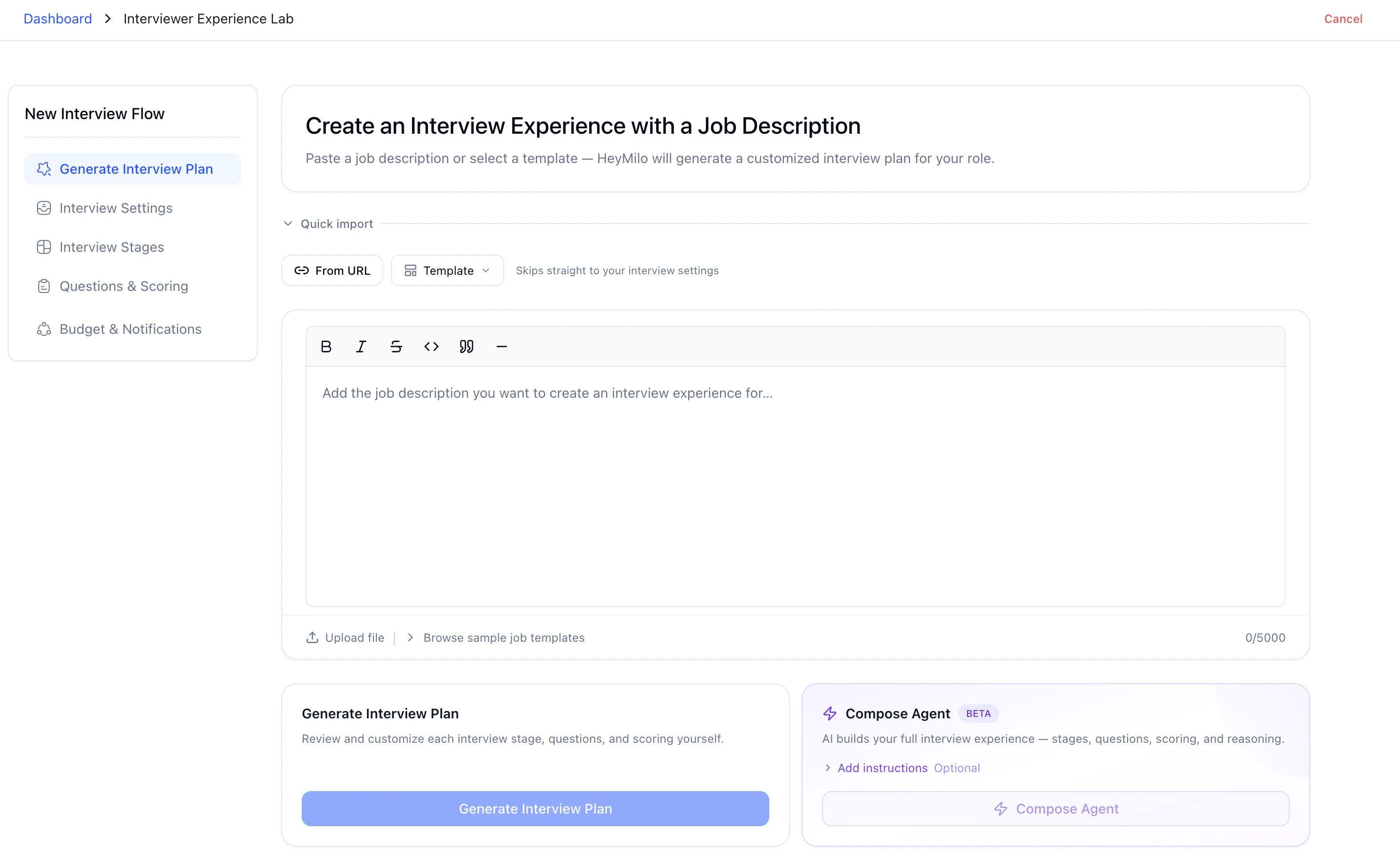
- Paste a job description — Paste your role description and HeyMilo will generate a customized interview plan.
- Use a template — Search job roles (e.g. Account Executive, Customer Support Representative) and pick a template to start from.
- Job posting URL (optional) — Enter a URL to pull the job description from a job posting page.
Compose Agent
Compose Agent is for when you want HeyMilo to generate the whole interviewer for you: which stages to use, the questions, the scoring, and how responses are evaluated.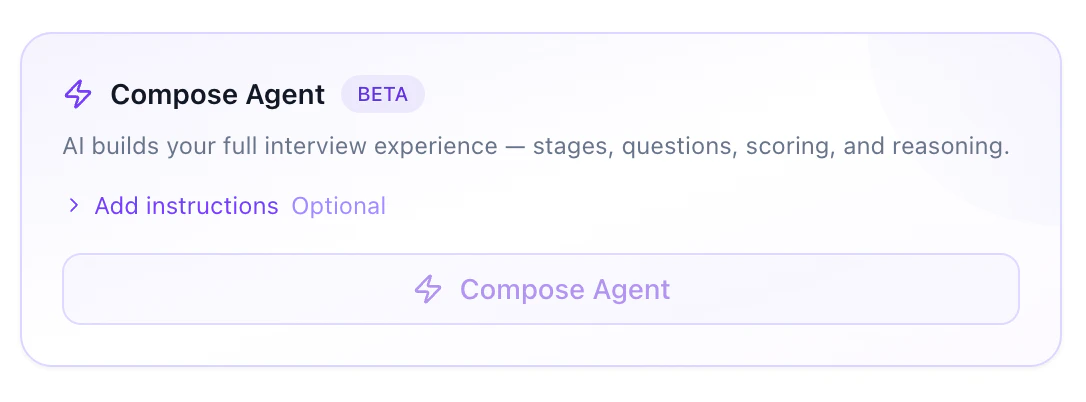
- Templates — Pick a role template as a starting point when it fits.
- Add instructions — You can even say the flow you want in plain language (e.g. SMS → resume → voice).
- Paste context — Job copy, intake notes, or a meeting transcript so the draft matches how you actually run the screen.
3. Configure how it looks to candidates
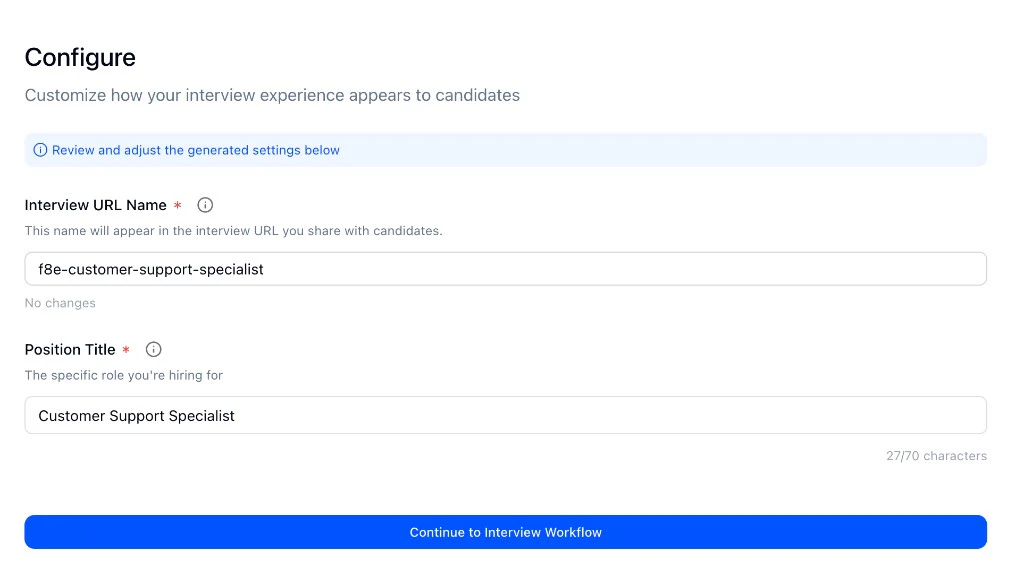
Next you’ll see Configure: set how this interview appears to candidates.- Interview URL Name — This becomes part of the link you share (e.g.
f8e-customer-support-specialist). You can keep the generated one or change it. - Position Title — The role title candidates see (e.g. “Customer Support Specialist”). Has a character limit.
4. Set up your interview stages
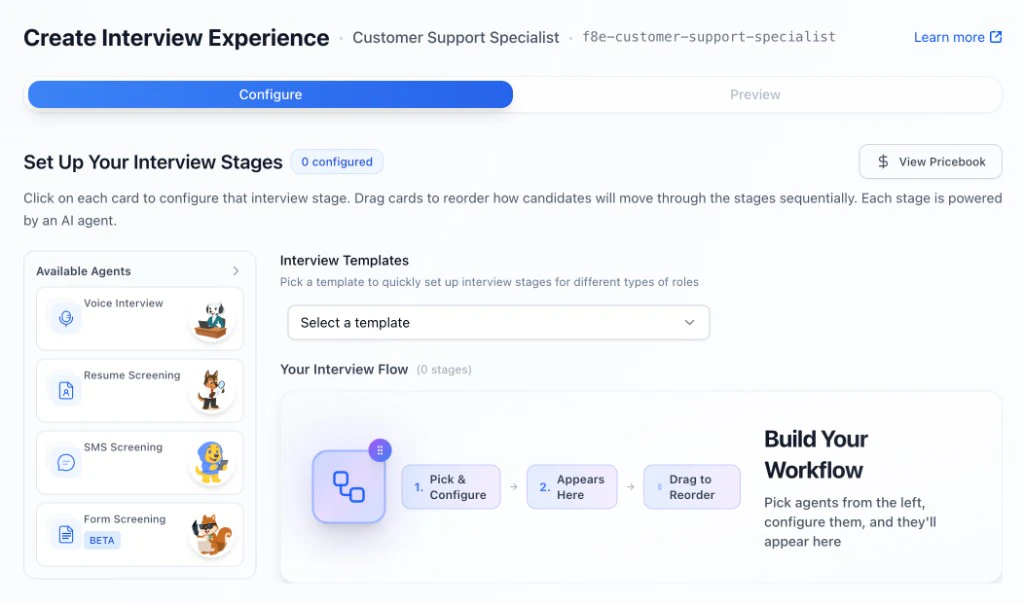
Here you build the sequence of screening steps. Each step is an AI agent (voice interview, resume screening, SMS, or form).- Available Agents — Voice Interview, Resume Screening, SMS Screening, Form Screening. Click a card to add and configure that stage.
- Your Interview Flow — Stages you add appear here. Drag to reorder how candidates move through them.
- Templates — Use “Select a template” to quickly set up stages for common role types.
5. Questions & scoring
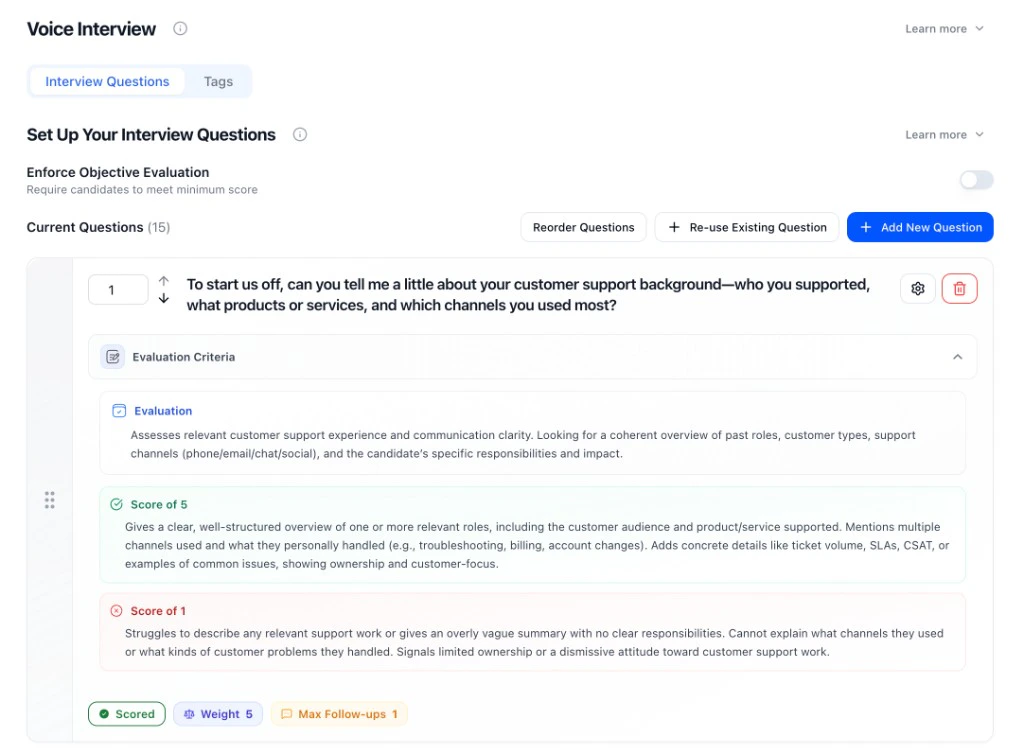
For each stage (e.g. Voice Interview), open Set Up Your Interview Questions.- Add questions — Your own, from the Question Library, or reuse from another interviewer. You can reorder and set how many follow-ups the AI can ask.
- Evaluation criteria — For each question, define what a strong vs weak answer looks like (rubric). Set a weight so more important questions count more toward the score.
- Enforce objective evaluation — Optional: require candidates to meet a minimum score to pass.
6. Interview settings (optional)
Before you go live you can set:- Agent identity — Single identity (seamless) or multiple (handoff experience).
- Language — Default interviewer language or auto-detect candidate language (BETA).
- Timeline — Deadline and “days to complete” after a candidate is added.
- Retakes — Whether candidates can retake if they don’t pass.
- Communication & branding — Email template group, design template, phone number for SMS/voice, whether to email the report to the candidate.
- Budget & notifications — Optional budget; email subscribers for completion alerts.
Timeline & expiration
While creating the interviewer: Settings → Timeline & Completion. Set when the posting expires for new candidates and how many days to complete after someone starts. Later on the dashboard: Open the interviewer and check Deadline at the top. Edit here to extend dates or time to finish.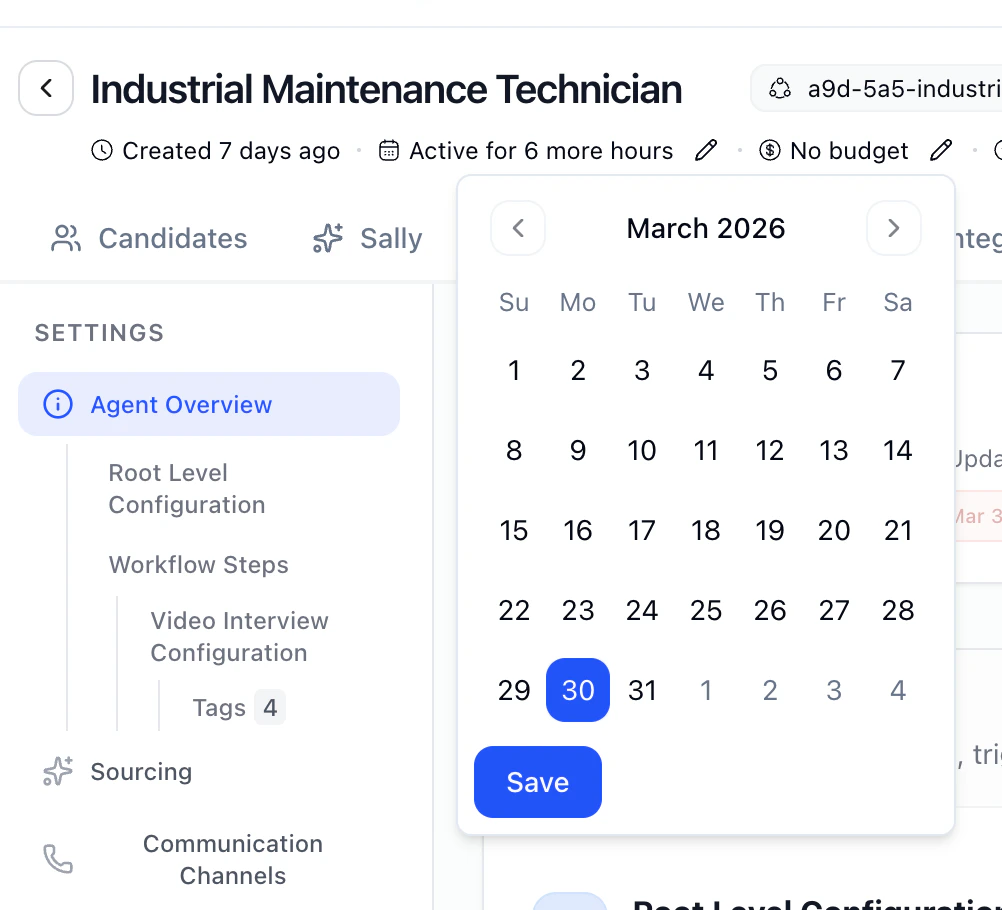
7. Share your interview
When setup is done, you’ll see Share with Candidates:- Interview link — Copy and share this link so candidates can start the interview. You can also print a poster.
- Connect to your ATS — Connect an ATS so candidates and results sync automatically. See ATS Integrations & quickstarts.
- Ingest — Use the webhook or ingestion gateway to send candidates from job boards, your site, or other tools.
Quick tips
- Clone to save time — Clone an existing interviewer from the dashboard to reuse stages, questions, and settings, then adjust. You can also use the Clone an interviewer API (Next Gen reference).
- Start simple — One voice or one SMS stage is enough to begin. Add more stages once you’re comfortable.
- Preview — Use Preview in the top nav to see how the interview looks to candidates before you share.
Next steps
- Interview Types — Voice, SMS, form, resume: when to use each
- Configuring Your AI Interviewer — Questions, rubrics, and settings in depth
- Inviting Candidates & Driving Completion — Get candidates to complete
Configuring your AI interviewer
Configuring Your AI Interviewer
This is where you decide what qualifies a candidate and how HeyMilo evaluates them at each stage. Every stage has a Questions & Scoring section you can configure. Set clear criteria and weights so every candidate is evaluated fairly and consistently.What you can customize (all stages)
For every question or criterion you can:- Edit the wording
- Choose how it’s evaluated (scored vs pass/fail)
- Assign weight (how much it affects the overall score)
- Mark it as a dealbreaker (auto-disqualify if not met)
- Control follow-up behavior (voice/SMS)
- Reorder questions or criteria to control flow
Reordering and weights
- Reorder — Drag and drop questions or criteria to change the order candidates see. Put dealbreakers first to filter early; group related topics together.
- Weights — Higher weight = the question matters more in the final score. You don’t need to make everything high weight; many teams use the defaults. See How Scoring Works.
Resume Screening
Configure Required Qualifications (auto-disqualifiers) and Evaluation Criteria (scored items like relevance and experience). You can enforce a minimum score so only candidates who meet your threshold advance.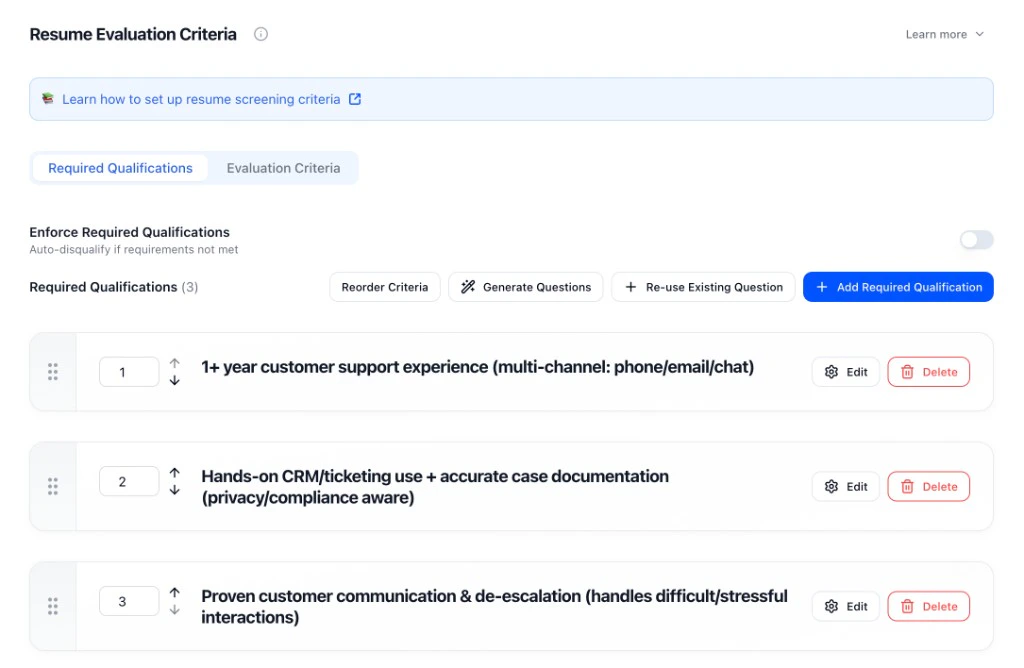
- Required Qualifications — Add must-haves (e.g. 1+ year support experience, CRM experience, communication skills). Toggle “Enforce Required Qualifications” to auto-disqualify when not met.
- Evaluation Criteria — Scored items for relevance, depth of experience, role fit.
- Reorder / Generate / Re-use — Reorder criteria, generate with AI, or re-use from another interviewer.
Application Form
Form questions collect structured answers and can enforce eligibility before candidates move on. Use Enforce Criteria so candidates who don’t meet requirements don’t advance.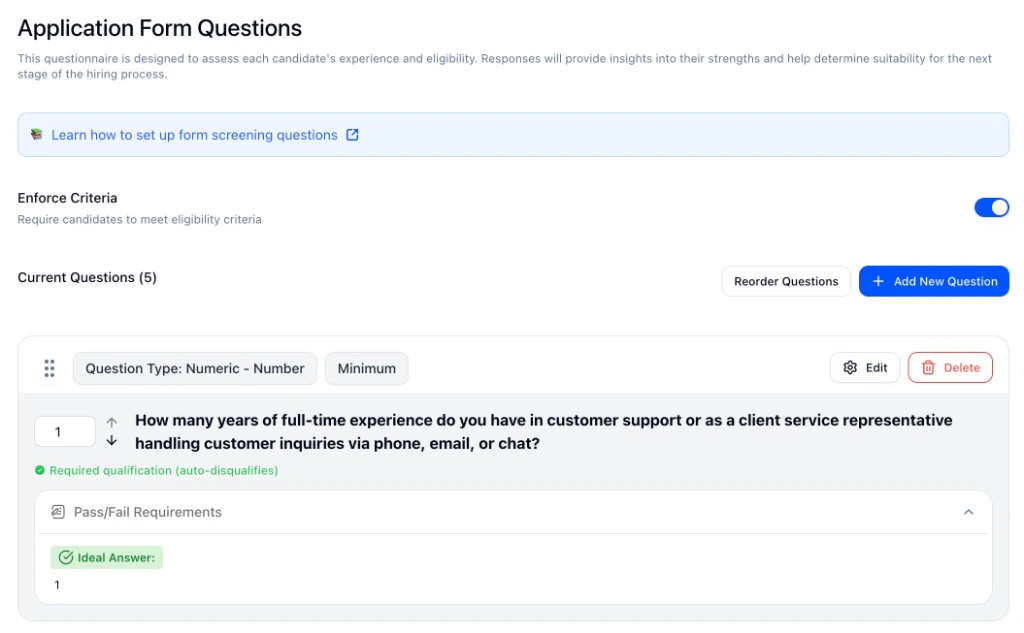
- Question types — Short answer, numeric (min/slider), multiple choice, date, file upload.
- Required qualification (auto-disqualifies) — Mark questions as dealbreakers with pass/fail requirements (e.g. minimum years of experience, ideal answer “1”).
- Reorder / Add — Reorder questions or add new ones.
SMS Screening
SMS is built for quick eligibility checks. Use Enforce Required Qualifications so candidates who don’t meet your pass/fail answers are auto-disqualified.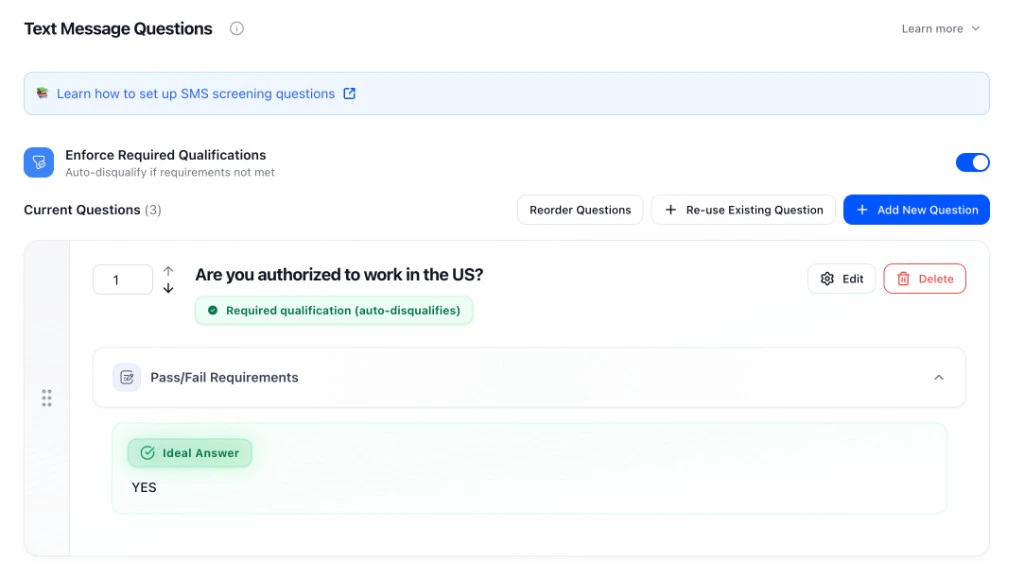
- Question types — Yes/no, numeric, pass/fail.
- Required qualification (auto-disqualifies) — Set the ideal answer (e.g. “YES” for work authorization). Candidates who don’t match don’t advance.
- Reorder / Re-use / Add — Reorder, re-use existing questions, or add new ones.
Voice/Video Interview
For voice and video, you define evaluation criteria for each question: what a strong answer looks like (score of 5) and what a weak answer looks like (score of 1). Set weight and how many follow-ups the AI can ask.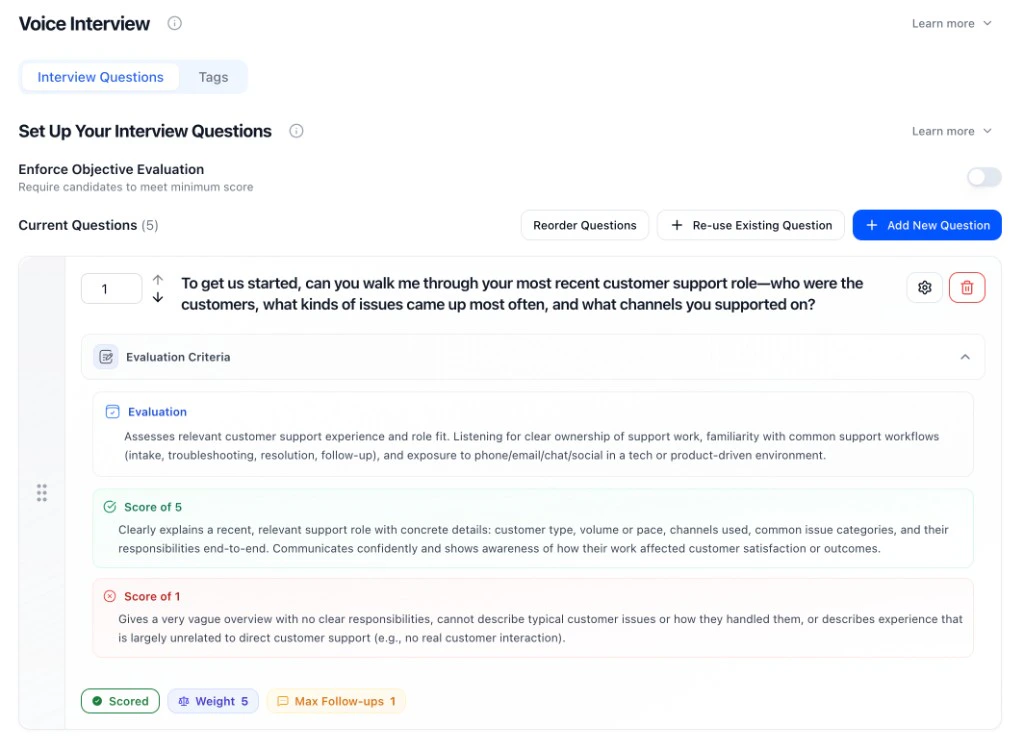
- Evaluation criteria — Describe what you’re listening for; define Score of 5 (strong) and Score of 1 (weak).
- Weight — How much the question affects the overall score (e.g. 1–10).
- Max follow-ups — How many follow-up questions the AI can ask to probe for more detail.
- Enforce Objective Evaluation — Optional: require candidates to meet a minimum score to pass.
- You can mix scored questions (1–5), structured (pass/fail, multiple choice), and informational (no score impact). See Question Library.
Dealbreakers vs scoring
- Dealbreakers = eligibility (work authorization, certifications, availability, hard minimums). Use required qualifications / enforce criteria so candidates who don’t meet them don’t advance.
- Scoring = quality (judgment, communication, depth of experience). Use evaluation criteria and weights so stronger answers rank higher.
Other settings
- Tags (optional) — Extract extra details from responses (e.g. years of experience, tools) without affecting the score. Tags appear in reports for filtering and review. See Interview Tags.
- Test before you launch — Every Questions & Scoring section has Test Now. Run through as a candidate to check wording, follow-ups, and scoring before you activate.
- Multilingual Support — Languages and voices. Cheat Detection — Interview Integrity.
Settings tab
Open the Settings tab (next to Integrations and Analytics). What you can edit vs view: Editable- Root Level Configuration — Edit language, interviewer name; under Advanced: Days to Complete, Scheduling URL, Redirect URL; Additional Context (company overview, job overview, interview process, instructions).
- Workflow Steps — Click a step (e.g. Resume, Video Interview) to edit that step’s questions, evaluation, and Enabled Features (turn video or phone on/off for that step, tags). Phone and video are per step, not one global toggle.
- Communication Channels — Set email template group, phone/messaging.
- Customizations — Set design template group (branding).
- Advanced Settings — Turn Cheat Detection, Test Posting, Deployed, Allow SMS, Email Report to Candidate, and retakes on or off.
- Sourcing — See what’s assigned; configure in Sourcing.
- Job Description — Shown to candidates; edit the description where you created the posting.
- Agent Mascot — Name and status (e.g. Live) are shown; created/updated time and deadline (e.g. “6 days remaining”) are displayed here.
Next steps
- How Scoring Works — How scores are calculated and what appears on reports
- Question Library — Reusable questions and AI generation
- Reviewing Candidates — Use score reports to advance or decline